
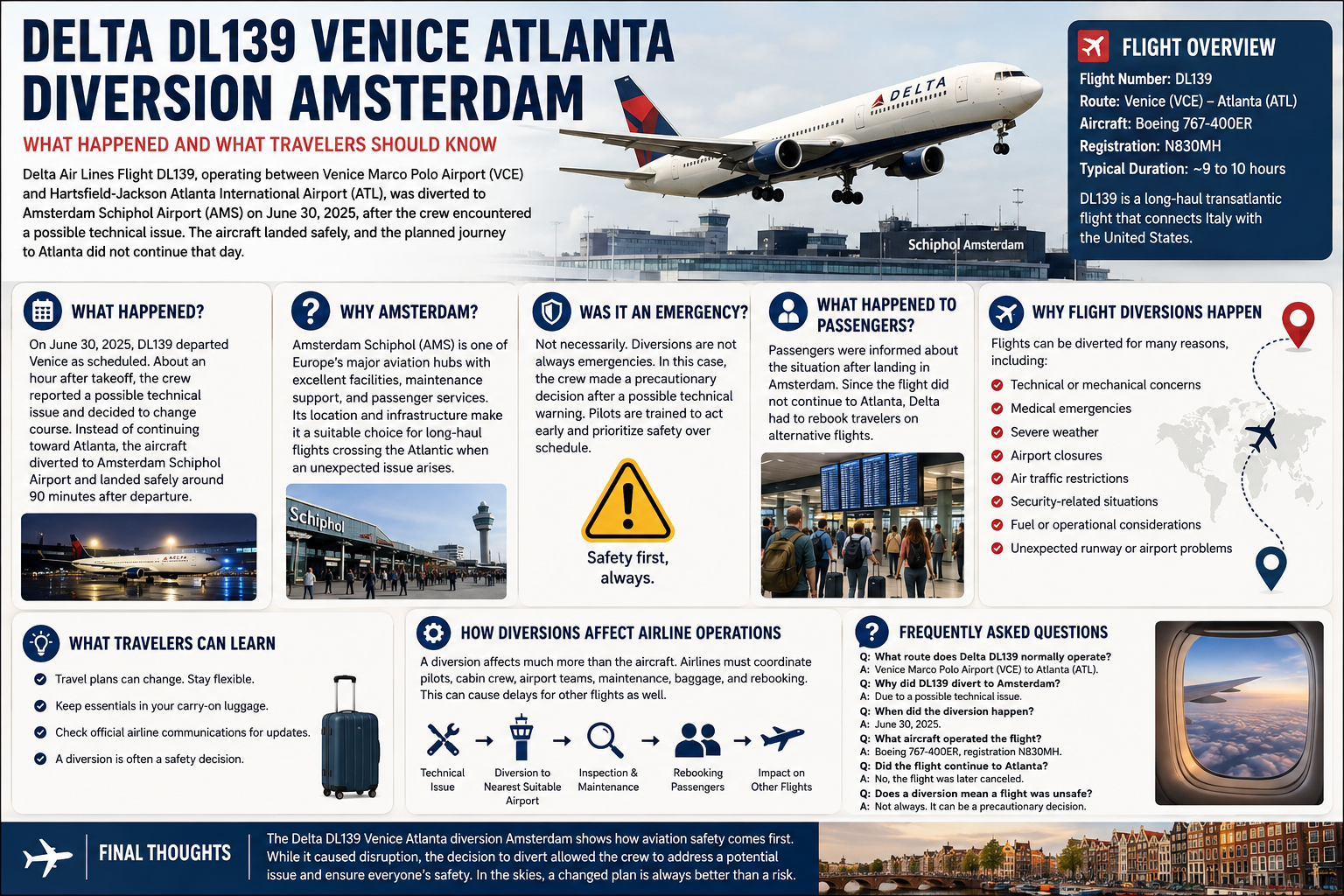
A transatlantic flight is usually planned with great care. Passengers board, the aircraft takes off, and the journey continues across the Atlantic toward the United States. However, aviation does not always follow the original plan. Delta DL139 Venice Atlanta diversion Amsterdam became an example of how quickly an international flight can change direction when a potential technical concern appears.
Delta Air Lines Flight DL139 normally operates between Venice Marco Polo Airport (VCE) in Italy and Hartsfield-Jackson Atlanta International Airport (ATL) in the United States. On June 30, 2025, the flight was diverted to Amsterdam Airport Schiphol (AMS) after the crew encountered a possible technical issue. The aircraft landed safely in Amsterdam, but the planned journey to Atlanta did not continue that day.
Delta DL139 Flight Overview
Delta DL139 is an international route connecting Venice with Atlanta. The flight is designed for long-distance travel and normally takes close to 10 hours, depending on winds, air traffic, and other operating conditions.
The route begins at Venice Marco Polo Airport and ends at Atlanta’s major international airport. Because it crosses the Atlantic, Delta normally uses wide-body aircraft suitable for long-haul operations.
Flight tracking records show that DL139 has operated with Boeing 767 aircraft on this route. During the June 30, 2025 diversion, the aircraft was identified as Boeing 767-400ER with registration N830MH.
What Happened to Delta DL139?
On June 30, 2025, Delta DL139 departed Venice for Atlanta as planned. The aircraft initially followed its scheduled route. However, roughly an hour after departure, the crew decided to change course.
Instead of continuing toward the Atlantic, the aircraft headed north toward Amsterdam. Reports stated that the decision was connected to a possible technical issue. The flight eventually landed safely at Amsterdam Schiphol Airport.
According to aviation reports, the aircraft landed on runway 06 approximately 90 minutes after departing Venice. It was then moved to a remote stand for further attention. The flight did not continue to Atlanta that day and was later canceled.
Why Was the Flight Diverted to Amsterdam?
The exact technical problem was not publicly explained in detailed terms. Reports consistently described it as a possible or suspected technical issue.
This distinction is important. A technical warning does not automatically mean an aircraft is in immediate danger. Modern commercial aircraft contain many monitoring systems. A warning from one of these systems can lead pilots to investigate the situation and decide whether continuing the flight is appropriate.
On a long transatlantic journey, crews have to consider many factors. These include the aircraft’s condition, remaining fuel, weather, available airports, maintenance support, and the distance to the destination.
If a potential problem appears early in a flight, landing at a suitable major airport can be a sensible safety decision.
Why Amsterdam Schiphol Was a Suitable Choice
Amsterdam Airport Schiphol is one of Europe’s major international airports. Its location and extensive aviation infrastructure make it suitable for handling large international aircraft.
For a flight traveling from Venice toward North America, Amsterdam can provide access to airport services, maintenance resources, airline personnel, passenger facilities, and onward connections.
This makes the airport a practical option when an aircraft needs to land unexpectedly in Northern Europe.
The Delta DL139 Venice Atlanta diversion Amsterdam also demonstrates why airlines consider alternative airports before and during long-distance flights. Pilots do not simply select an airport at random. They evaluate whether an airport can safely accommodate the aircraft and passengers.
Was the Diversion an Emergency?
It is important not to assume that every diversion is a serious emergency.
A diversion can be precautionary. Pilots are trained to respond to unusual indications before they become larger problems. Choosing to land early can therefore be a sign of careful risk management rather than evidence of a dangerous situation.
In the DL139 case, available reports indicate that the Boeing 767 landed safely in Amsterdam. The aircraft was parked at a remote stand, while the planned service to Atlanta was subsequently canceled.
For passengers, an unexpected diversion can still be stressful. However, from an aviation safety perspective, changing the destination can be the correct decision when the crew needs additional inspection or assistance.
What Happened to Passengers?
The diversion changed the travel plans of everyone aboard DL139.
Instead of reaching Atlanta directly, passengers found themselves in Amsterdam. Because the aircraft did not continue to Atlanta that day, Delta had to manage the disruption through rebooking and other passenger-support procedures.
Depending on individual circumstances, travelers affected by an international flight disruption may need information about replacement flights, accommodation, meals, baggage, and onward connections.
Passengers should always keep their booking details available during a disruption. Airline applications, airport information screens, customer-service desks, and official notifications can provide updates about the next available travel arrangements.
Why Flight Diversions Happen
The Delta DL139 Venice Atlanta diversion Amsterdam is one example of a much broader aviation practice.
Commercial flights can be diverted for many reasons, including:
- Mechanical or technical concerns
- Medical emergencies
- Severe weather
- Airport closures
- Air traffic restrictions
- Security-related situations
- Fuel or operational considerations
- Unexpected runway or airport problems
The most important point is that a diversion is not necessarily a sign that something catastrophic has happened.
Airlines plan for unexpected events. Flight crews receive extensive training for abnormal situations, while dispatchers and ground teams help identify suitable airports and coordinate the next steps.
Why Technical Problems Are Taken Seriously
Aircraft systems are designed with multiple layers of monitoring and redundancy. Pilots receive information about engines, electrical systems, hydraulics, pressurization, navigation, and other important functions.
If an unusual indication appears, the crew follows established procedures. Sometimes the issue can be resolved while the aircraft continues flying. In other cases, the safest option is to land at a suitable airport.
This approach explains why a flight can turn around or divert even when passengers do not notice anything unusual inside the cabin.
The goal is not to wait until a small concern becomes a serious problem. Instead, aviation procedures encourage crews to manage risks early.
What Travelers Can Learn From DL139
The incident offers several useful lessons for international travelers.
First, travelers should avoid assuming that a scheduled arrival time is guaranteed. Long-distance flights can be affected by circumstances outside the airline’s original plan.
Second, keeping essential items in carry-on luggage can make an unexpected delay easier to manage. Passengers should consider carrying medication, chargers, travel documents, and basic necessities where they can access them easily.
Third, travelers should monitor official airline communications during disruptions. Flight-tracking websites can show useful information, but the airline remains the primary source for rebooking and passenger instructions.
Finally, passengers should remember that a diversion is often made with safety in mind.
How Diversions Affect Airline Operations
A diversion affects much more than the aircraft itself. Airlines must coordinate pilots, cabin crew, airport personnel, maintenance teams, baggage operations, and passenger rebooking.
An aircraft that arrives unexpectedly at another airport may also need inspection before it can return to service. This can affect later flights because aircraft and crew schedules are connected across the airline’s network.
That is why one diversion can sometimes create delays for passengers who were never on the original flight.
The DL139 event illustrates how a single technical concern can become a complicated operational challenge for an international airline.
Frequently Asked Questions About Delta DL139
What route does Delta DL139 normally operate?
DL139 normally connects Venice Marco Polo Airport in Italy with Hartsfield-Jackson Atlanta International Airport in the United States.
Why did DL139 divert to Amsterdam?
Reports from the incident stated that the crew diverted because of a possible technical issue. The aircraft landed safely in Amsterdam.
When did the diversion happen?
The reported diversion occurred on June 30, 2025. The flight departed Venice and landed in Amsterdam roughly 90 minutes later.
What aircraft operated the flight?
The aircraft involved was a Boeing 767-400ER, registration N830MH.
Did the aircraft continue to Atlanta?
No. Reports stated that the flight was later canceled and did not continue to Atlanta that day.
Does a diversion mean a flight was unsafe?
Not necessarily. Diversions can be precautionary decisions made when pilots identify a situation that requires additional inspection or support.
Final Thoughts
The Delta DL139 Venice Atlanta diversion Amsterdam shows how commercial aviation responds when an unexpected situation develops during a long-distance flight. What began as a routine journey from Venice to Atlanta changed when the crew decided to divert to Amsterdam after a possible technical concern.
Although the diversion caused inconvenience for passengers, the aircraft landed safely, and the planned service was canceled rather than continuing without resolving the issue.
For travelers, the event is a reminder that aviation safety depends on careful decisions, trained crews, reliable airport infrastructure, and strong contingency planning. A change of destination may be frustrating, but when safety is involved, reaching the destination later is always better than taking unnecessary risks.
You May Also Like : Tatavel
6 thoughts on “Delta DL139 Venice Atlanta Diversion Amsterdam: What Happened and What Travelers Should Know”